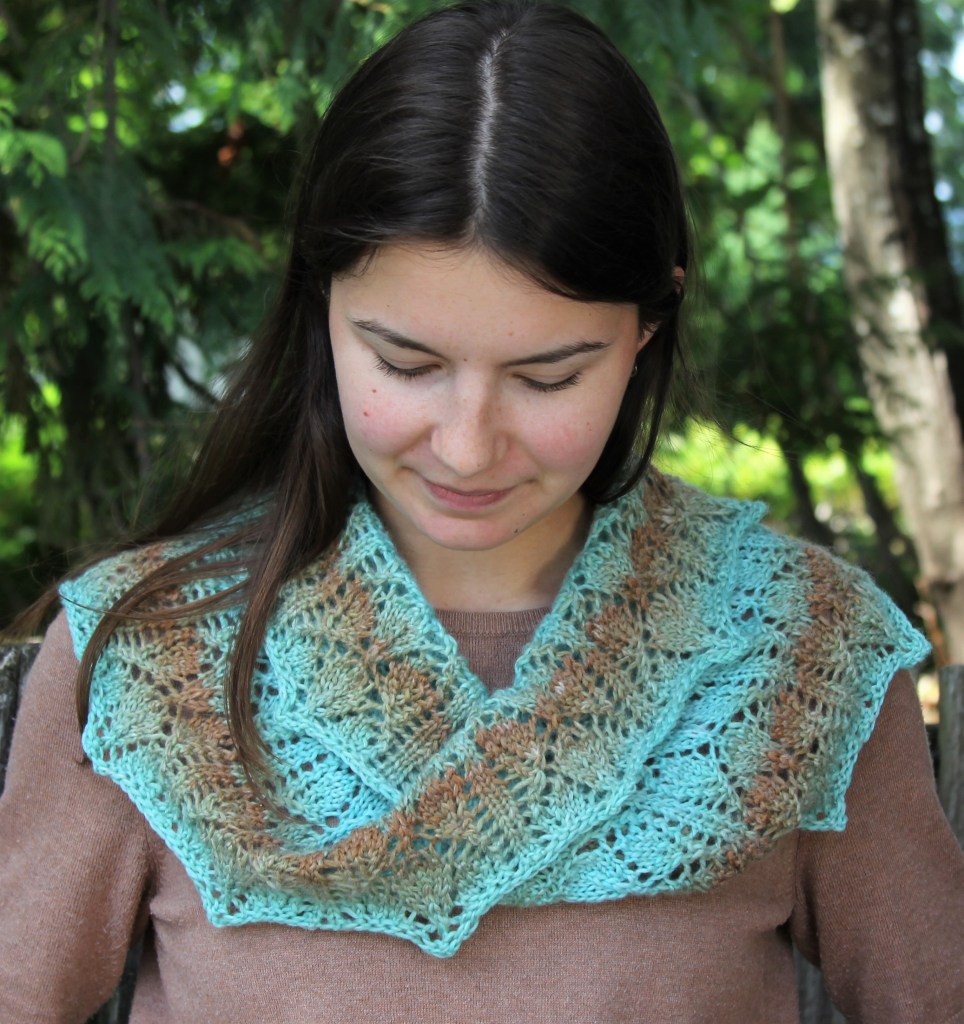
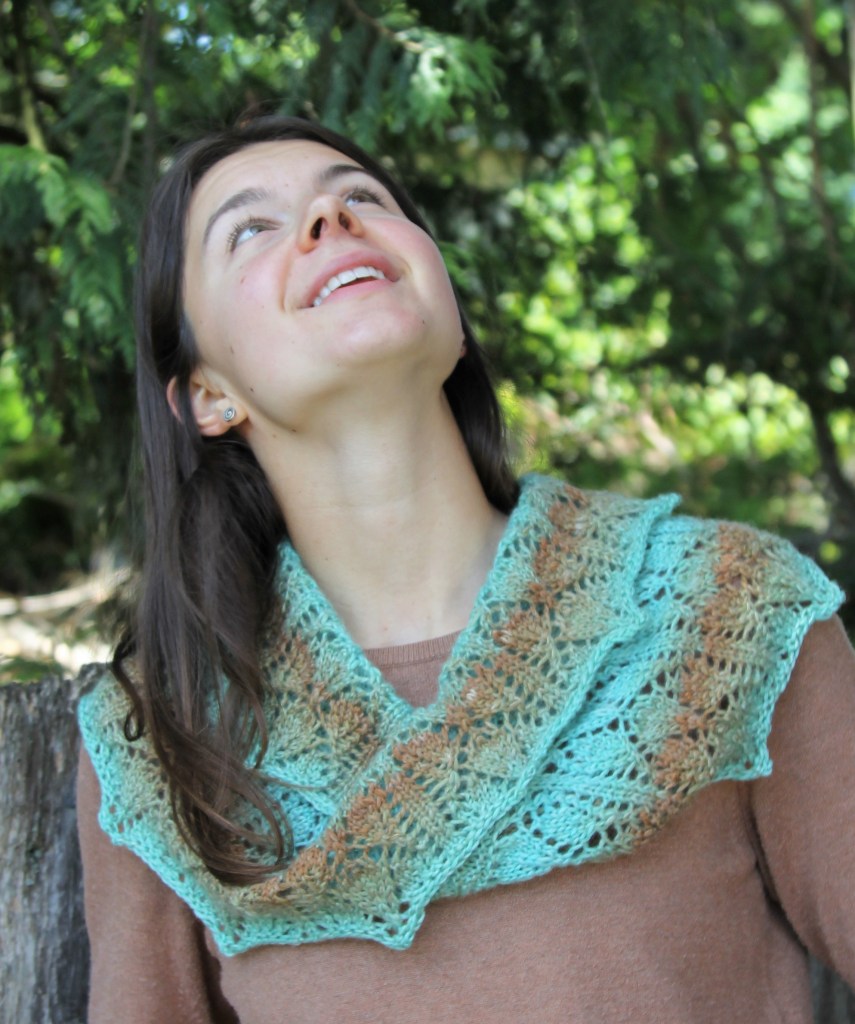
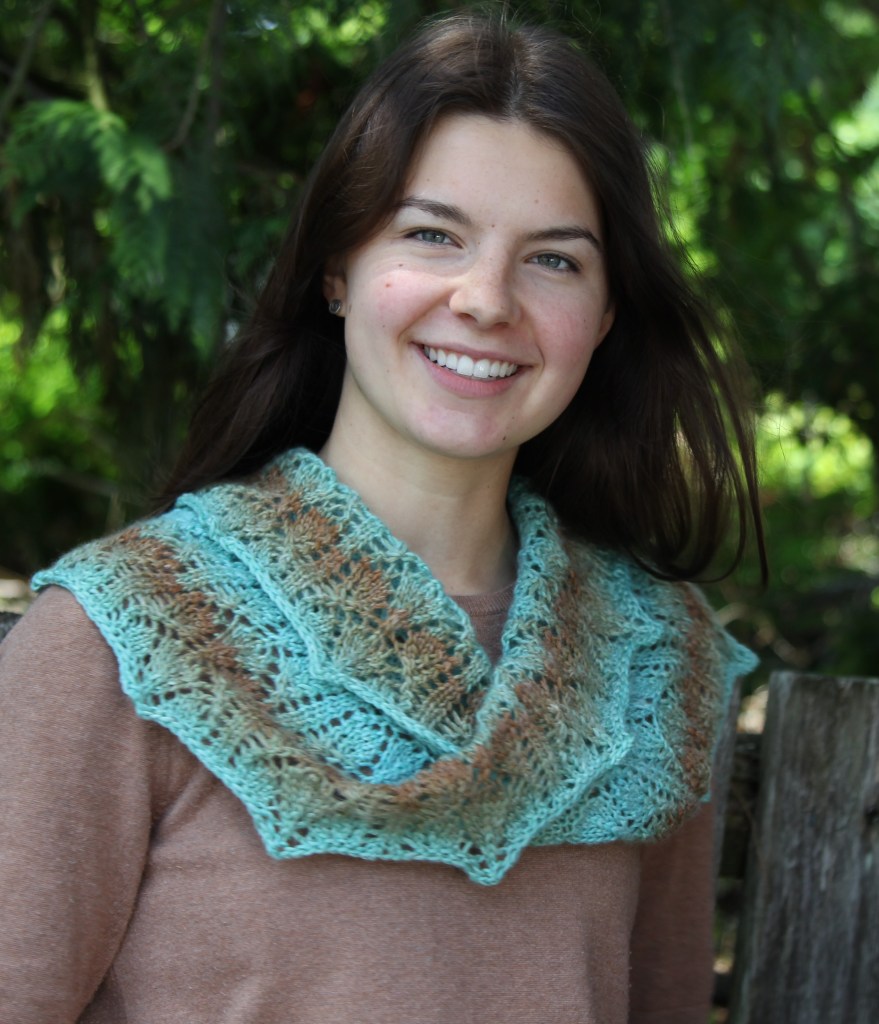
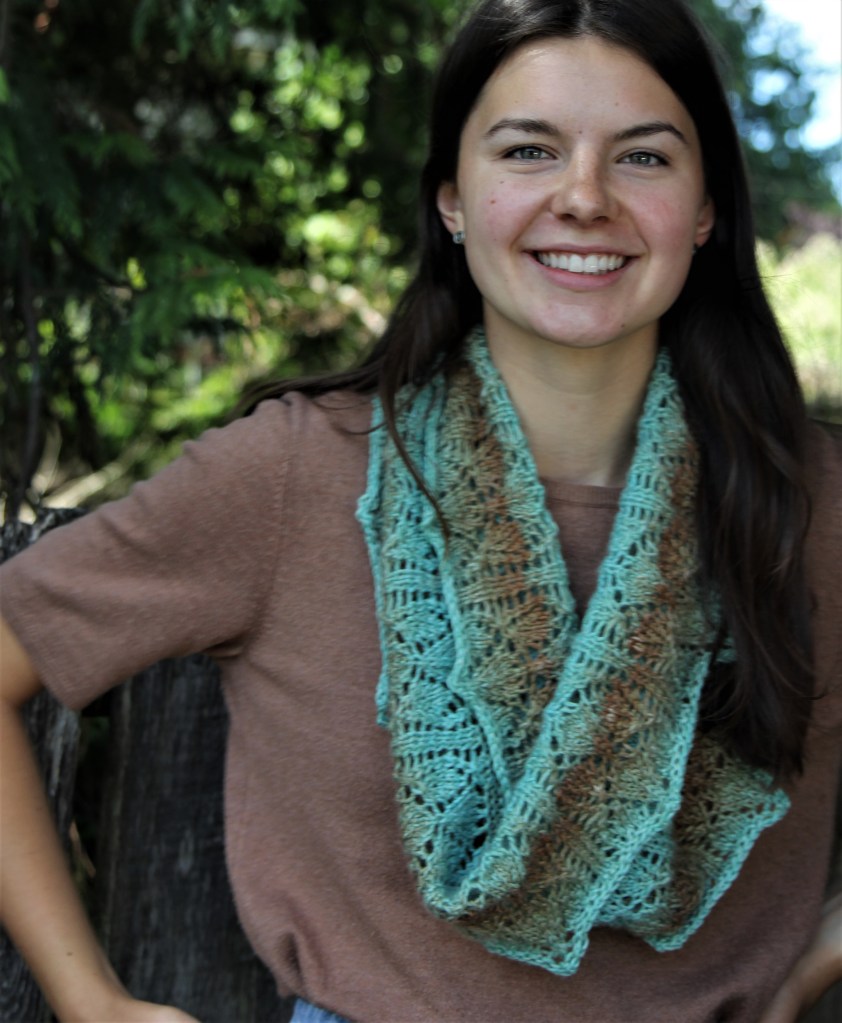
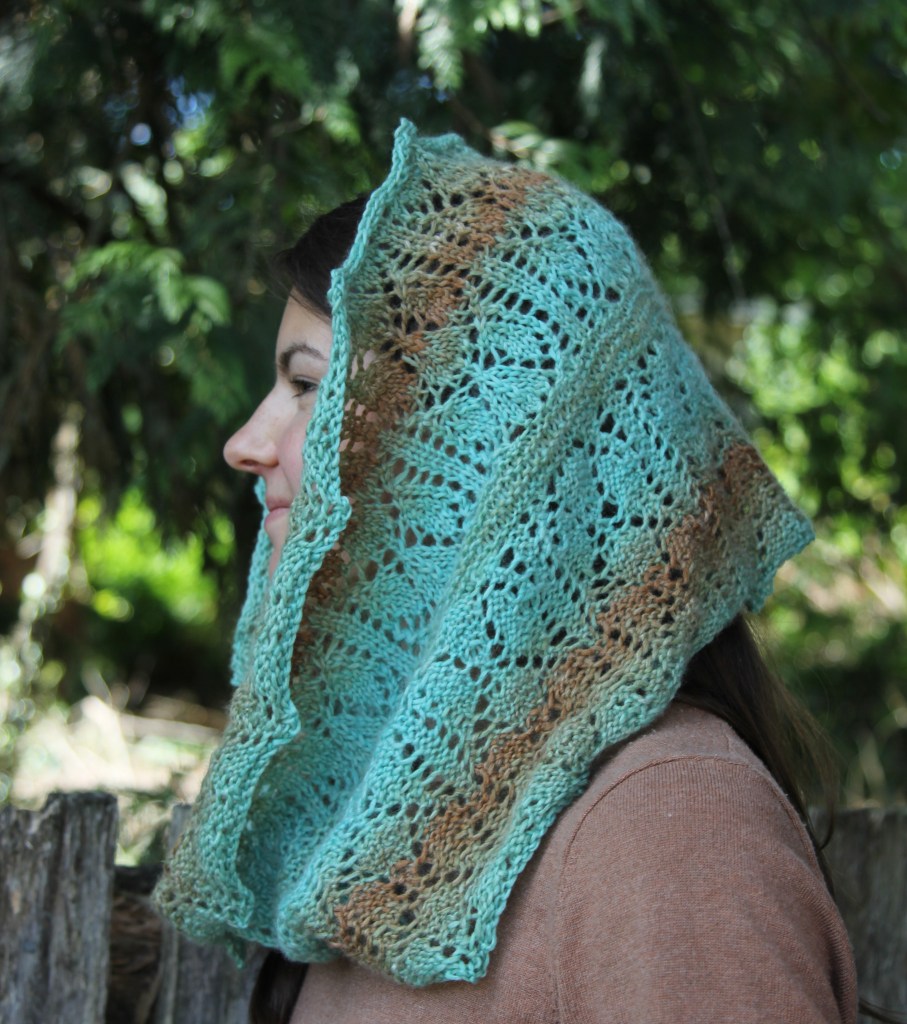
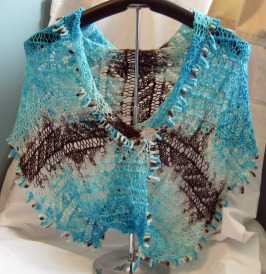
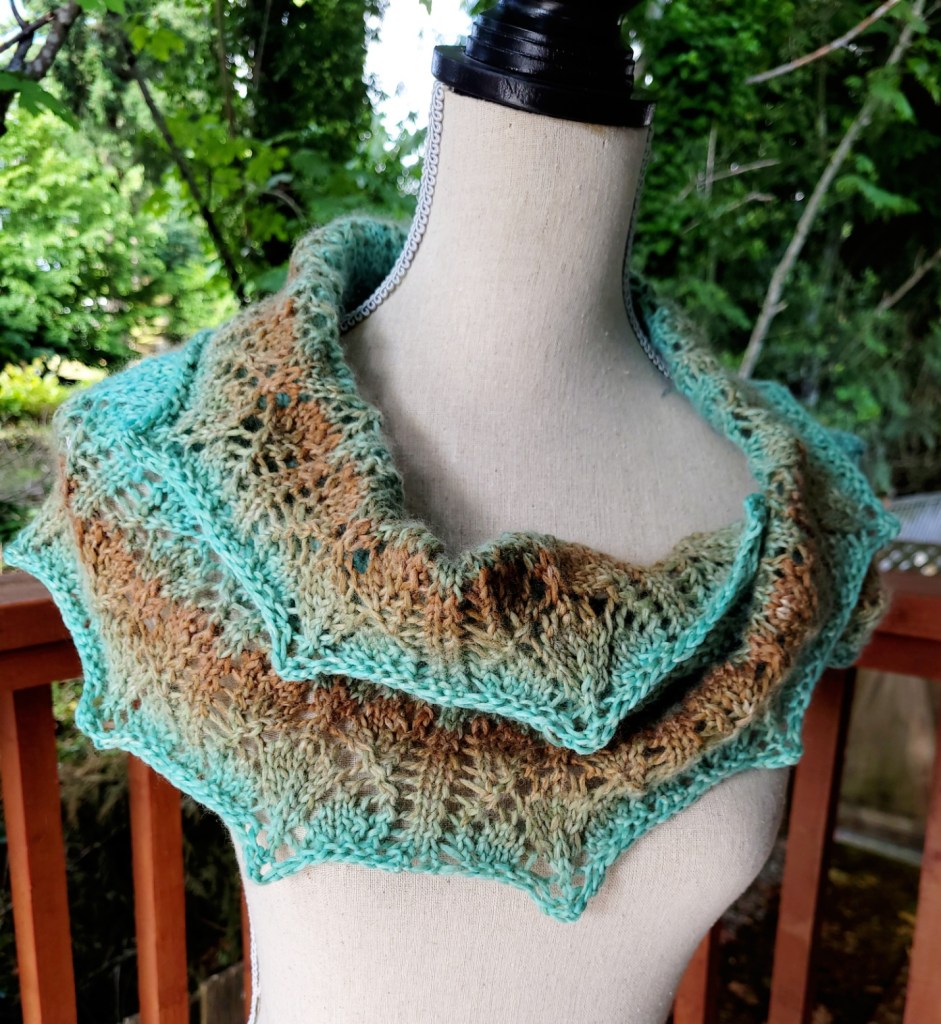
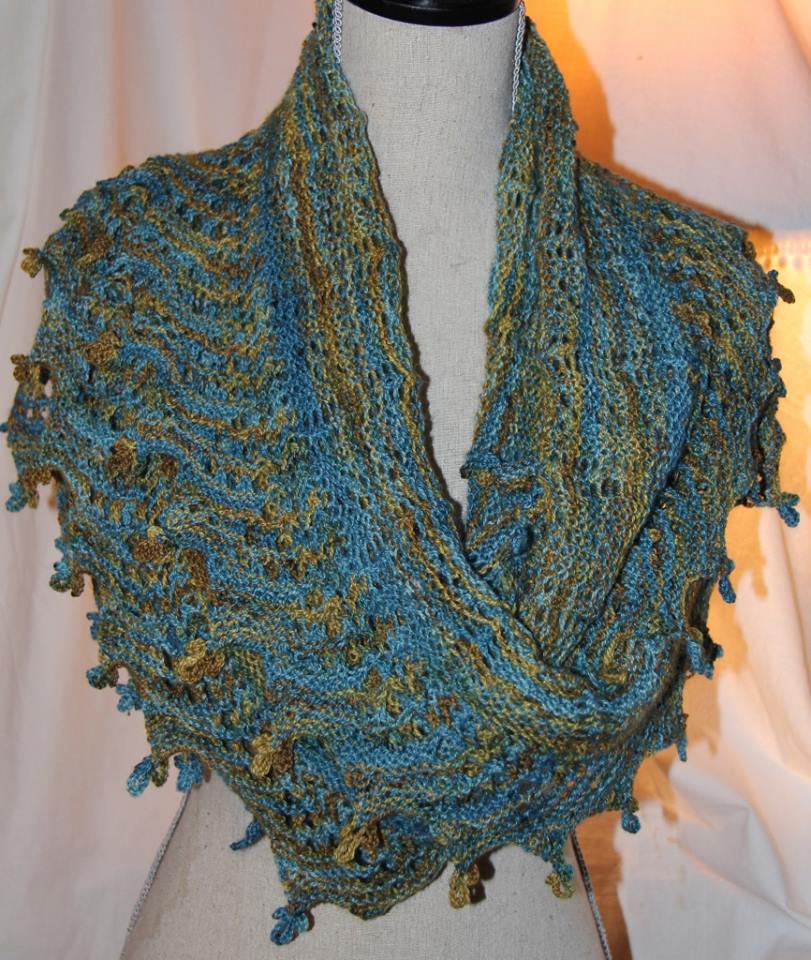
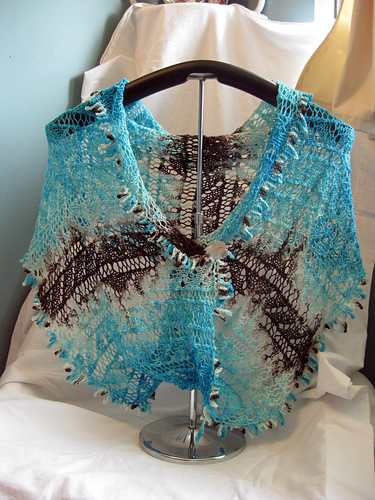
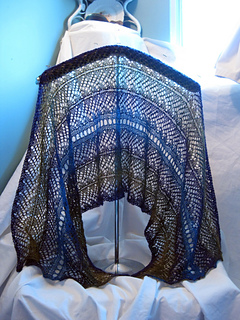
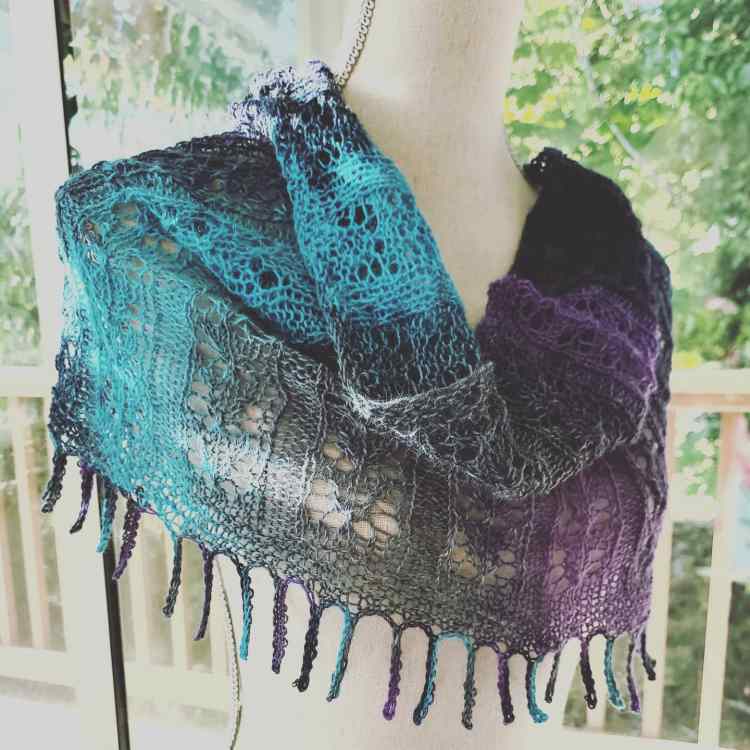
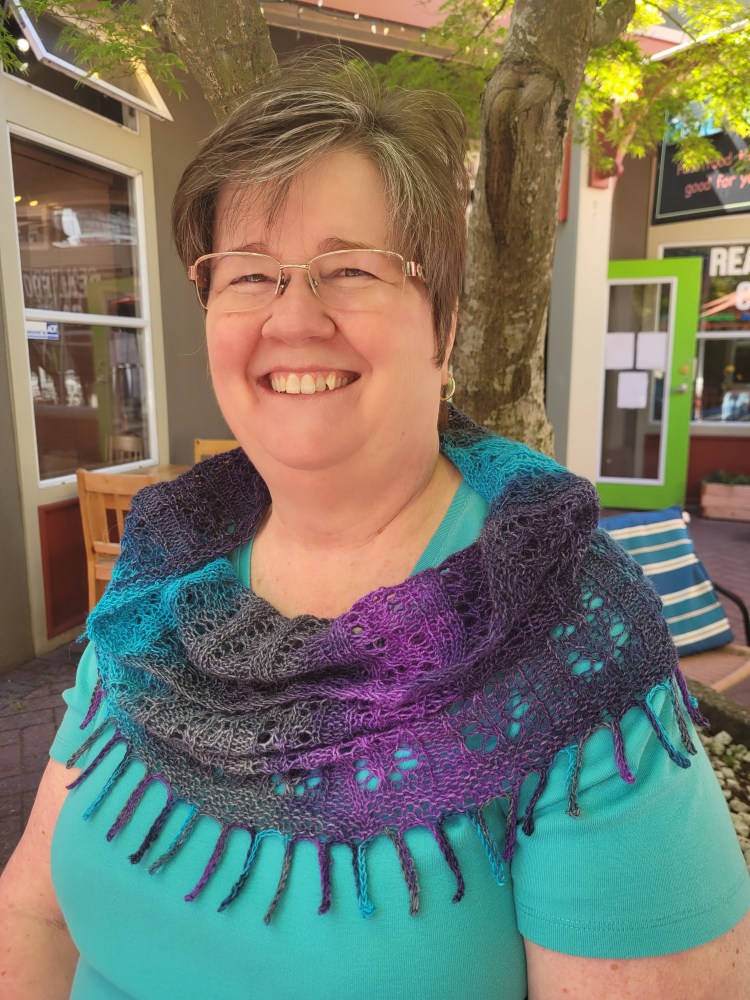
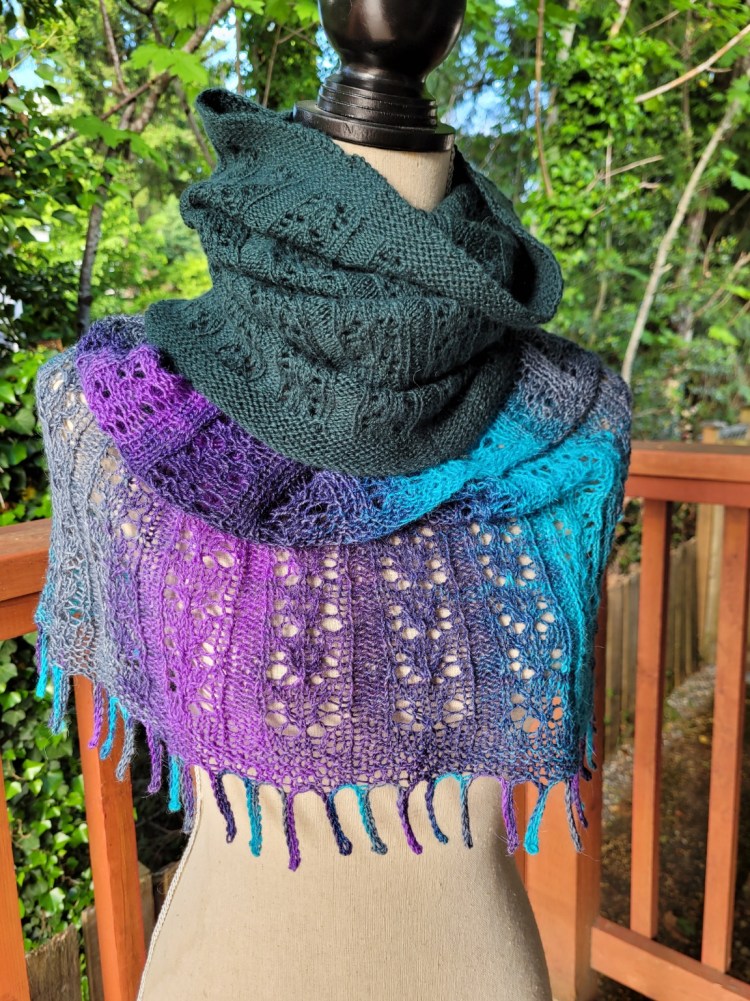
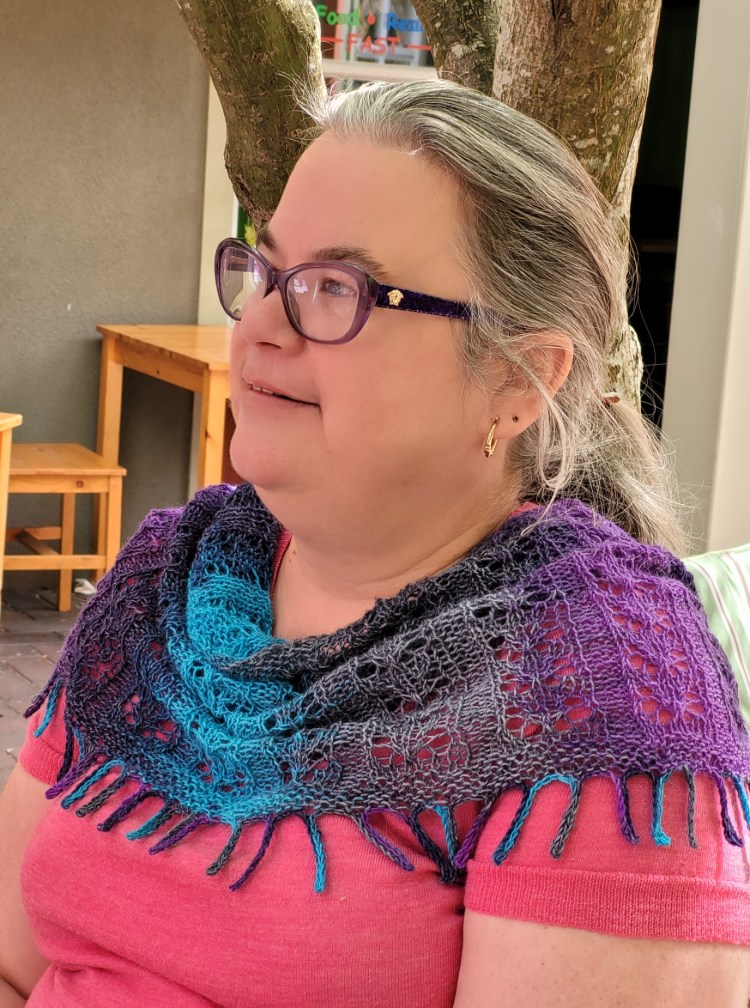
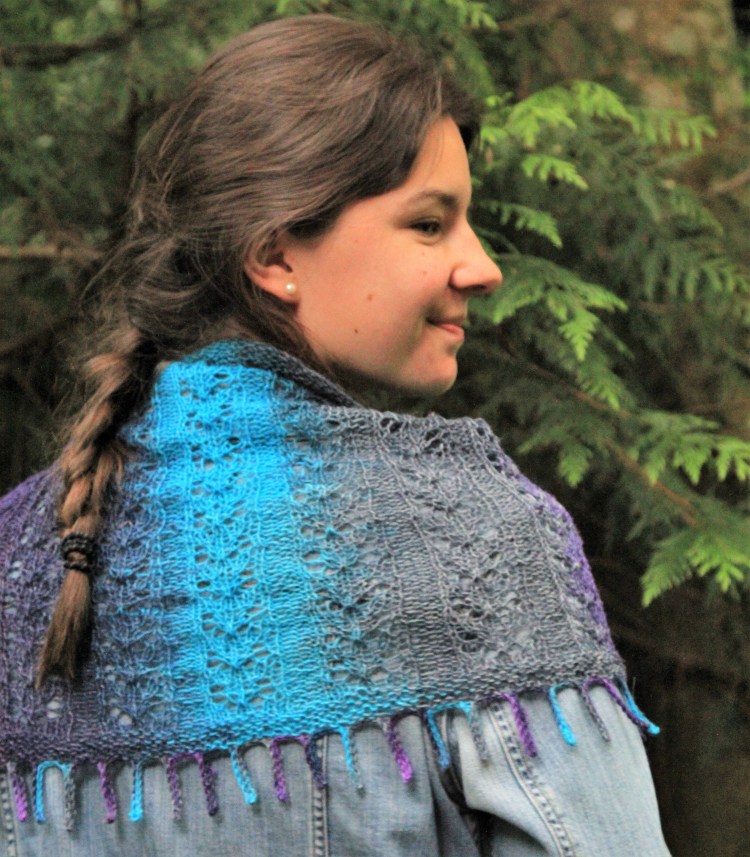
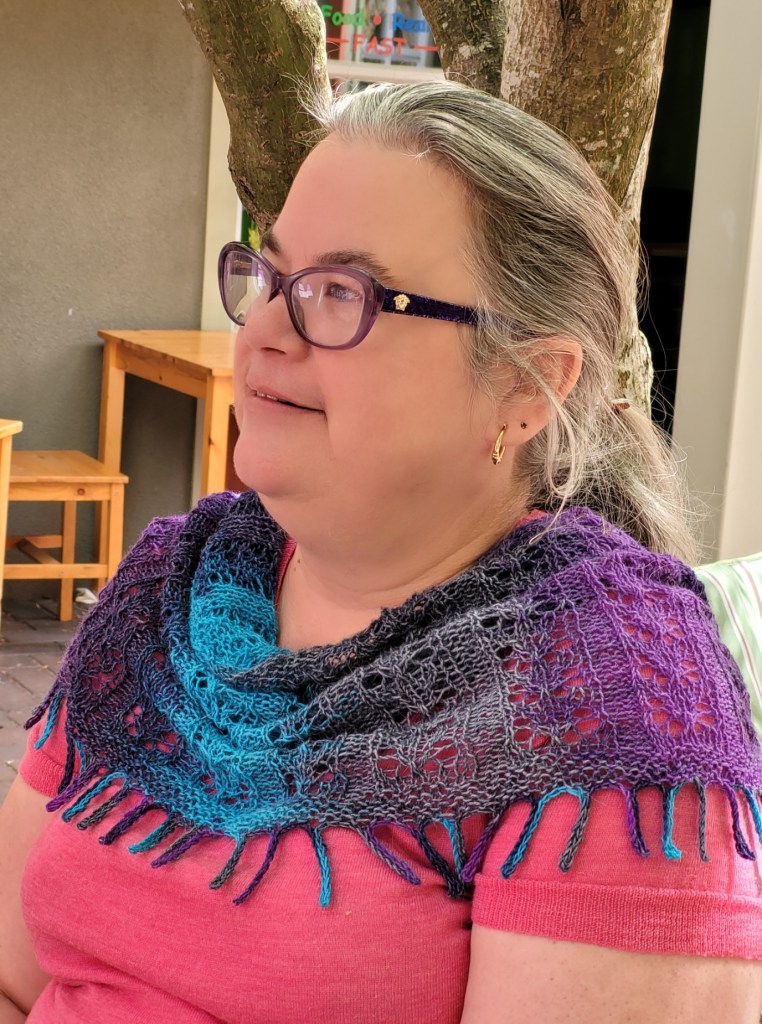
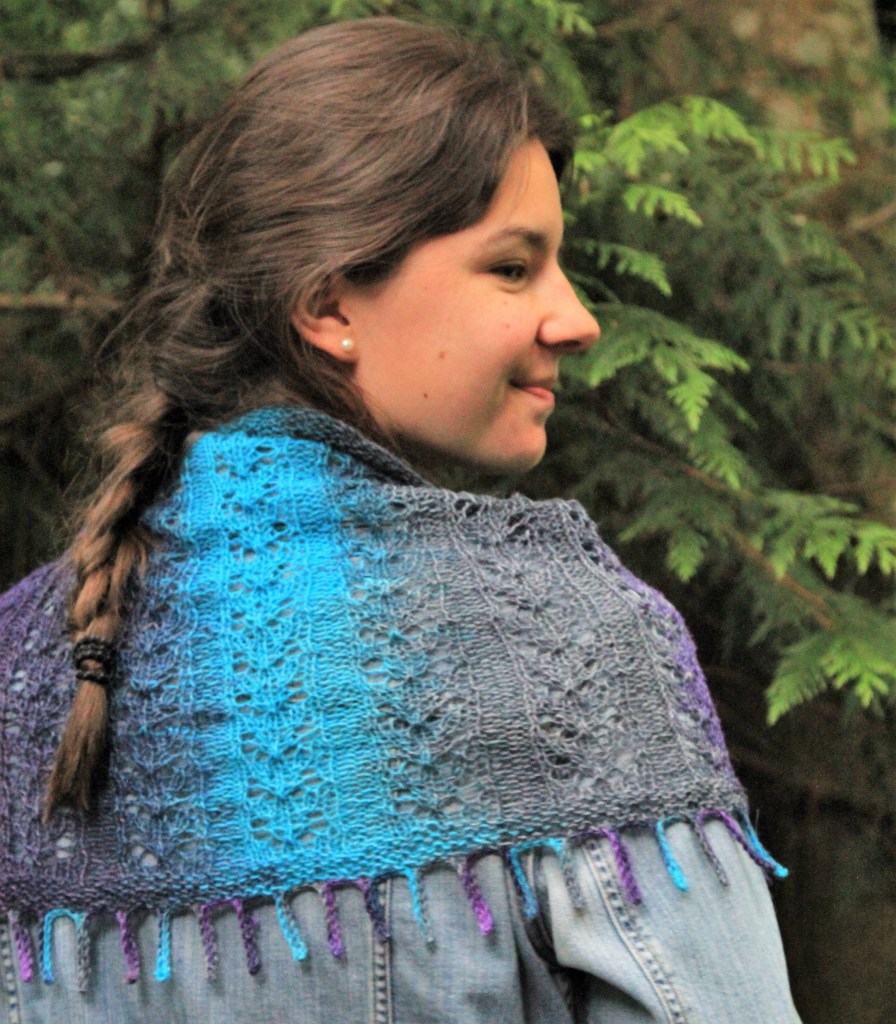
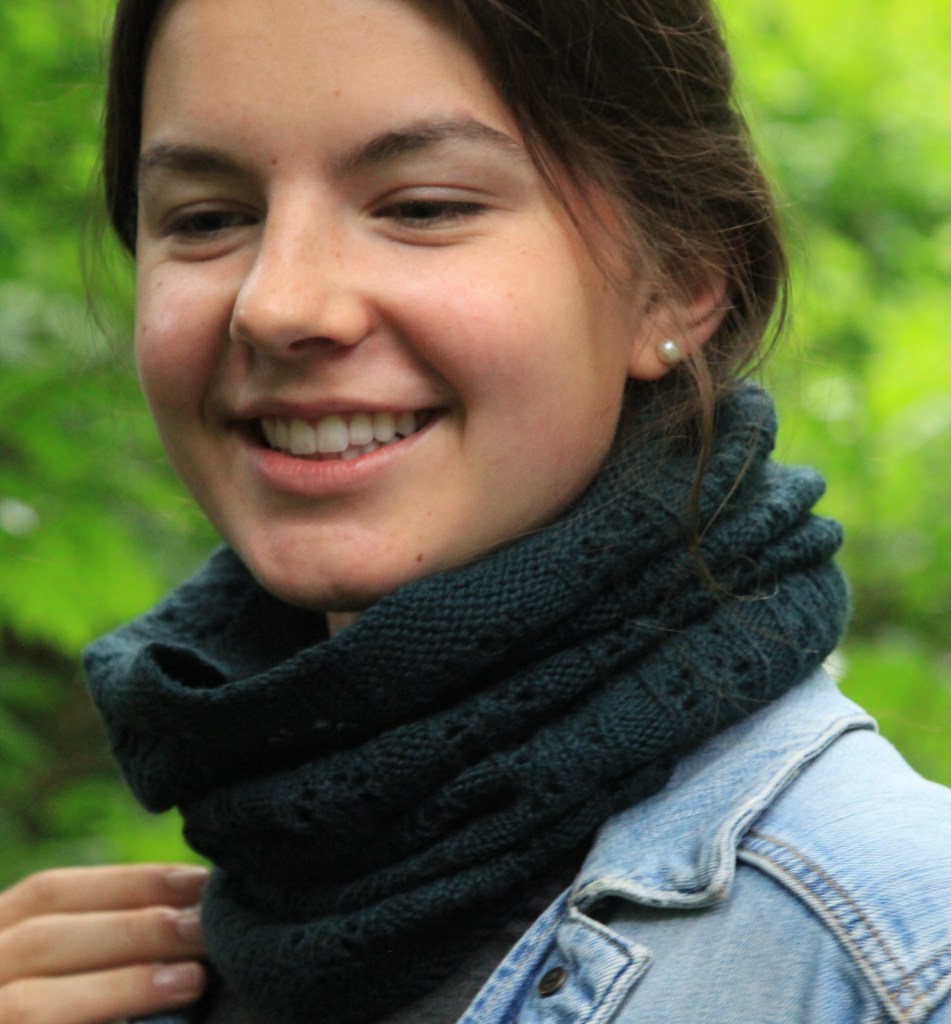
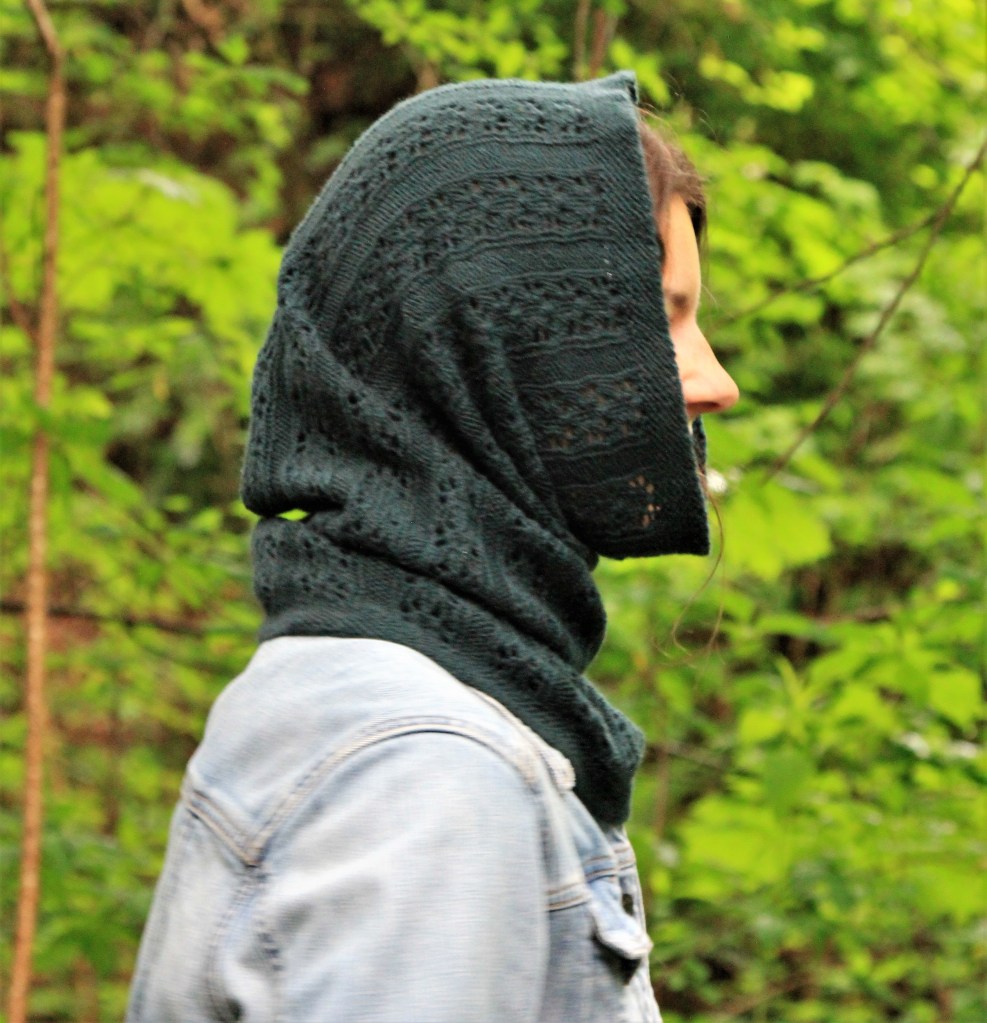
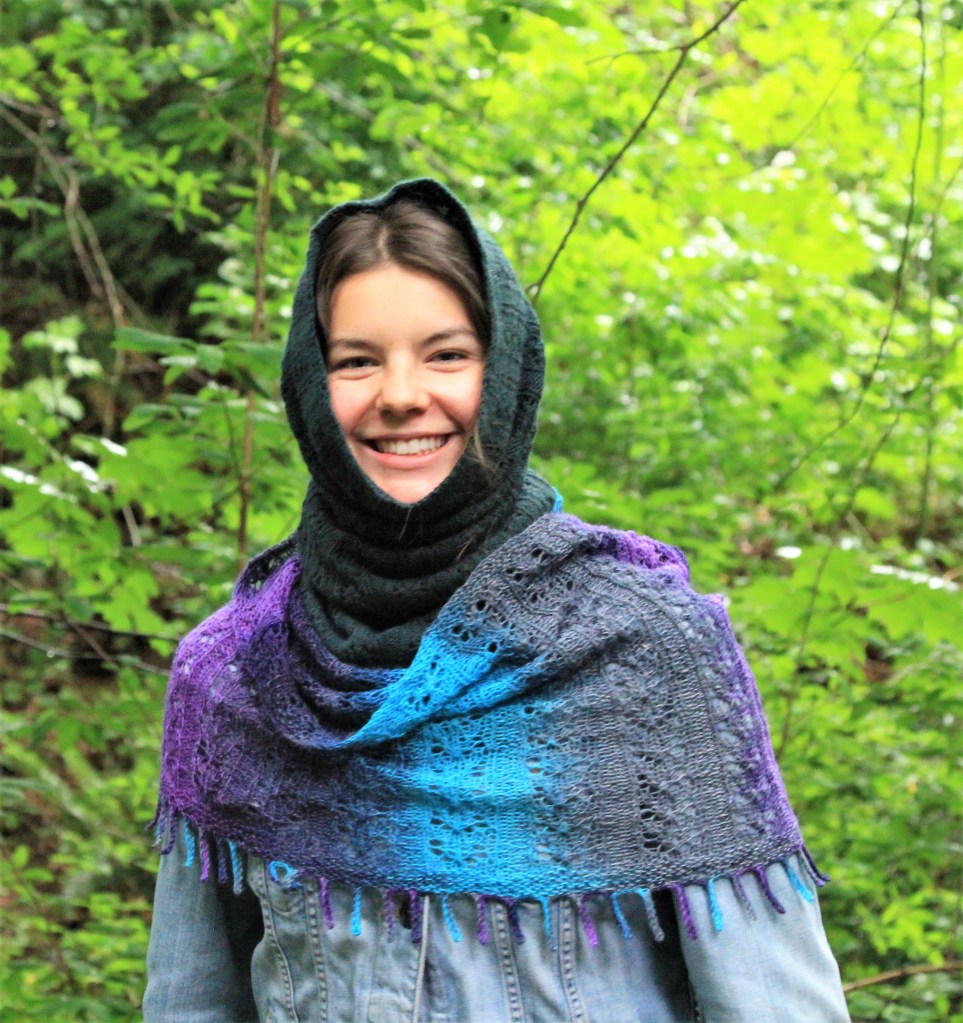
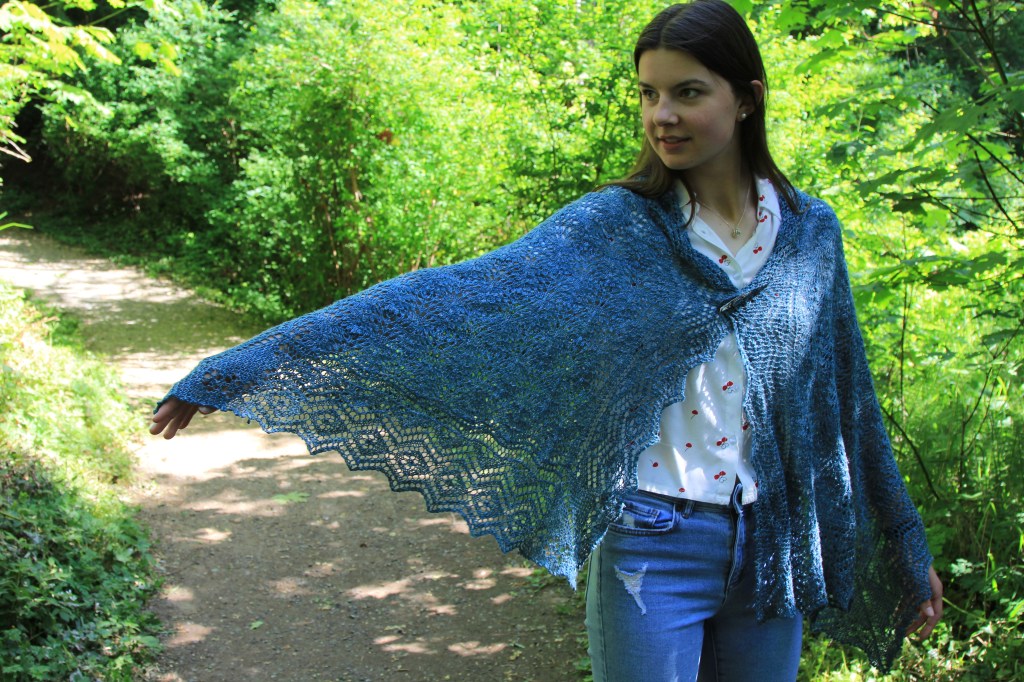
Tri Leaf Moebius is the twelfth pattern in the Just Playing Around Ebook.
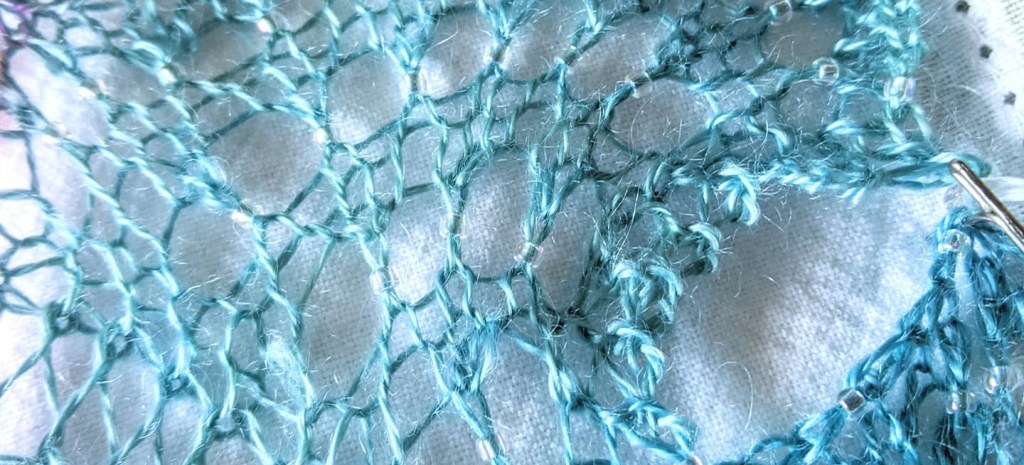
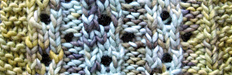
The yarn is Schoppel-Wolle Cashmere Zauber, a lovely soft blend of merino and cashmere. The colour gradation is long and slow so that the lace pattern is not impacted by the colour changes, only enhanced.
This pattern would look great in a solid. A soft alpaca or cashmere from your stash perhaps.
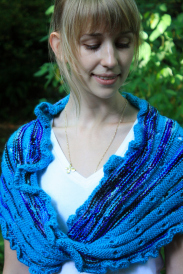
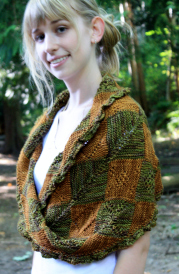
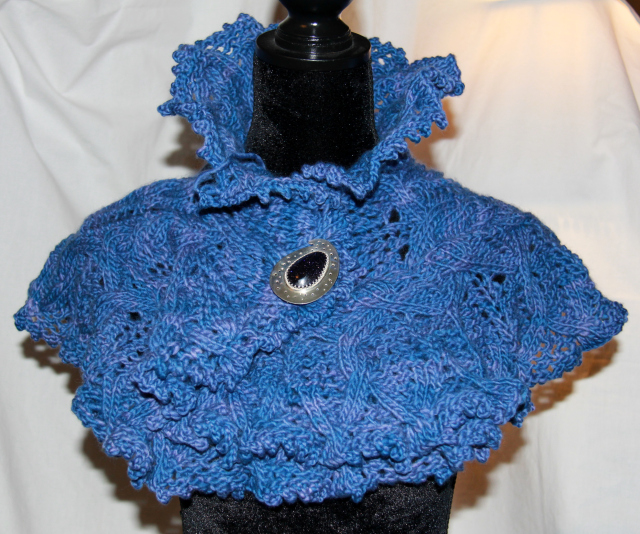
A Moebius is a very entertaining knit. The cast-on and first round can be a little fiddly but the result is so worth it. The moebius shaping paired with a soft yarn creates an interestingly graceful cowl.
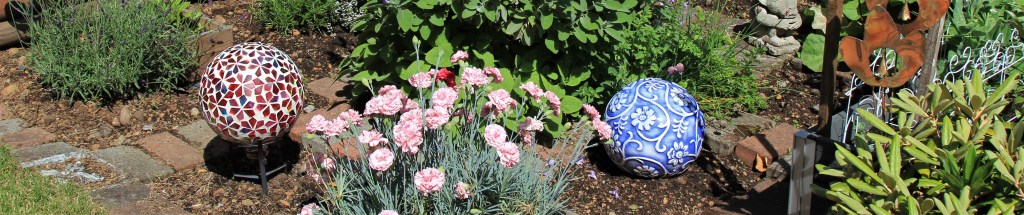
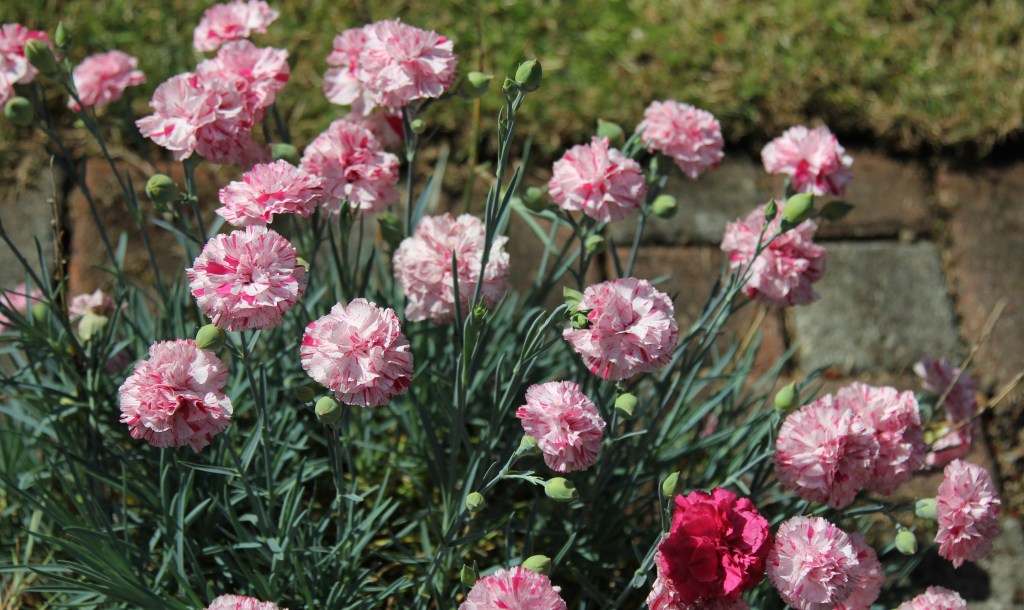
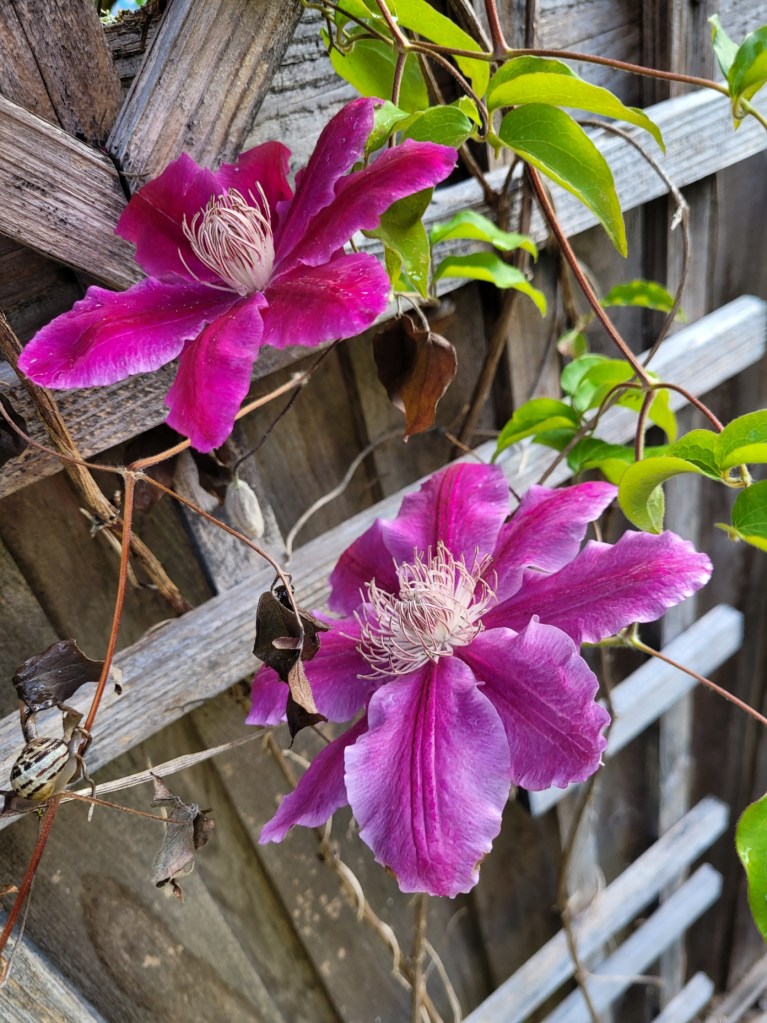
The garden is growning and the flowers are blooming. The Poppy is done, as is the Clematis, But the Dianthus is blooming for the first time ever. I moved it from the front yard, where the deer ate every bud just before blooming, to the back yard where this year it is putting on a stellar show.
The guilty party – isn’t he handsome though! He lives in the lot next door a great deal on the time.
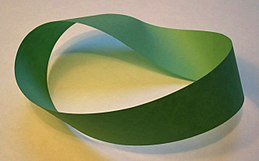
A Moebius is a mathematical concept discovered in the late 1800’s by two scientists working independently of each other. Like the wheel, like knitting, it was it’s time to be discovered.
Above is Möbius strip made with a piece of paper and tape. If an ant were to crawl along the length of this strip, it would return to its starting point having traversed the entire length of the strip (on both sides of the original paper) without ever crossing an edge. Wikipedia
One type of Moebius – the scarf – in knitting is often called an Infinity Scarf. It can be created a couple of different ways. The most common and easiest method of creation is by knitting a basic scarf and giving it a half twist before sewing the two end together. Just like the piece of paper above.
If you give the scarf a full twist it will no longer be a Moebius and it will just be twisted.
And why is Cat Bordhi’s Technique so interesting?
Cat Bordhi must have an amazing mind, to come up with such a unique cast-on and create a totally new way of looking at the way we knit! Elizabeth Zimmermann once said that there is nothing truly new in knitting – new things to us are usually “unvented”, and just recently re-discovered! Cat Bordhi truly “invented” something new and added to the body of work that is Knitting.
The Moebius cast-on resembles a modified provisional cast-on; but is not provisional and becomes the two center rounds of your garment. Like some cast-on’s, provisional or otherwise this cast-on is “un-tensioned” and requires patience for the first half of the round of knitting – the second half of the round is easy. From the Moebius cast-on, like any other cast-on, a knitter can knit almost any kind of stitch and create a unique garment.
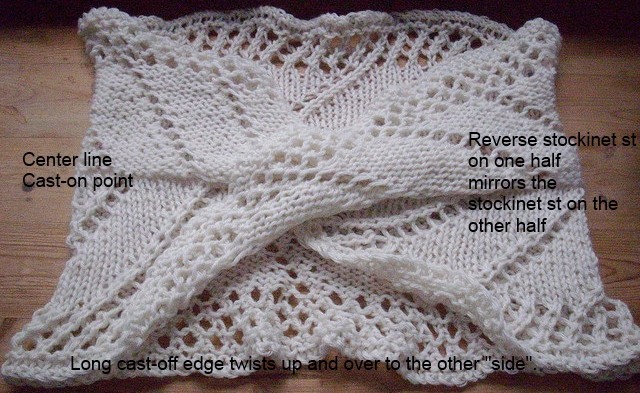
Be prepared – each half of the curve is the mirror image of the other half. For example; if every round after the cast-on is knit, one half of the moebius will appear as stockinet and the other half as reverse stockinet. Because of this a reversible stitch is recommended for those knitters who want both sides to be visually the same.
A long needle – at least 40″ – I like a 47″ – is required for the cast-on as you will be working with the needles doubled, circled around each other. Each half round takes one half of the length of the needle. In reality the round you are working with is only 20″ to 30″ long.
As you knit the Moebius you will see the cords holding the two halves start to separate as each round takes them further from the cast-on and moves them closer to the final edge for cast-off.
The moebius cast-on creates a unique shape that can showcase any type of stitch or knitting technique.
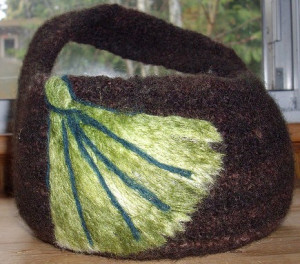
Cat Bordhi did not limit her cast-on to infinity scarves alone. She went on to create some amazing felted bowls and cat beds and other vessels – all starting with the Moebius cast-on.
Once the books were out of print. Cat Bordhi shared the cast-on on You-tube and made sure that it would not be forgotten. Cat Bordhi passed away Sept 19th 2020. I did not know her personally, but I “knew” her through her work. It was a great loss for all.
If you have never played with this cast-on it is one that is worth exploring as it offers interesting possibilities for the adventurous knitter. Not hard to do, just trust the instructions and try it out!
Pooling in knitting is the deliberate knitting of hand-dyed yarn so that the colours stack upon each other or move in such a way as to create a definite pattern, such as Argyle. There are some machine dyed variegated yarns that can create very interesting pooling as well.
A few years ago I tried pooling several different yarns with varying results. The resulting ebook was called Just “Pooling” Around.
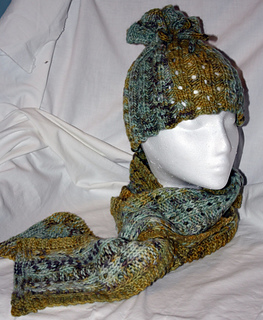
Hidden Pools Scarf and Hat, River Moebius and Delphinium Shawl are from Just “Pooling” Around
I just finished another pooling project. A version of my new pattern Pinecones Cowl.
From yarn to finish – Pooling Pine cones – Darlene and I both like the results. Elise too, it looks great on us all.
I had forgotten how much fun it could be. When it works well! Or how frustrating it could be when the “drift”, colour movement, gets out of hand! Still it was more fun than frustrating! And I am very pleased with the results.
So it must be a good day to release a new pattern. Meet Pinecones Cowl. A fast and easy knit for you or for a gift. Infinitely versatile and can be used to try out a new technique – pooling.
The pooling cowl is for me! My favourite colours all in one easy to wear piece. A rare photo of me (I never like pictures of me). wearing the pooling cowl.
Elise and I got together this morning for a quick photo shoot! In the rain! But it was fun and went well. I love to photograph my knits in different lights and at different times of the day. Morning light, on grey days is my favourite, there just seems to be a freshness about it – the colours seem to come out better.
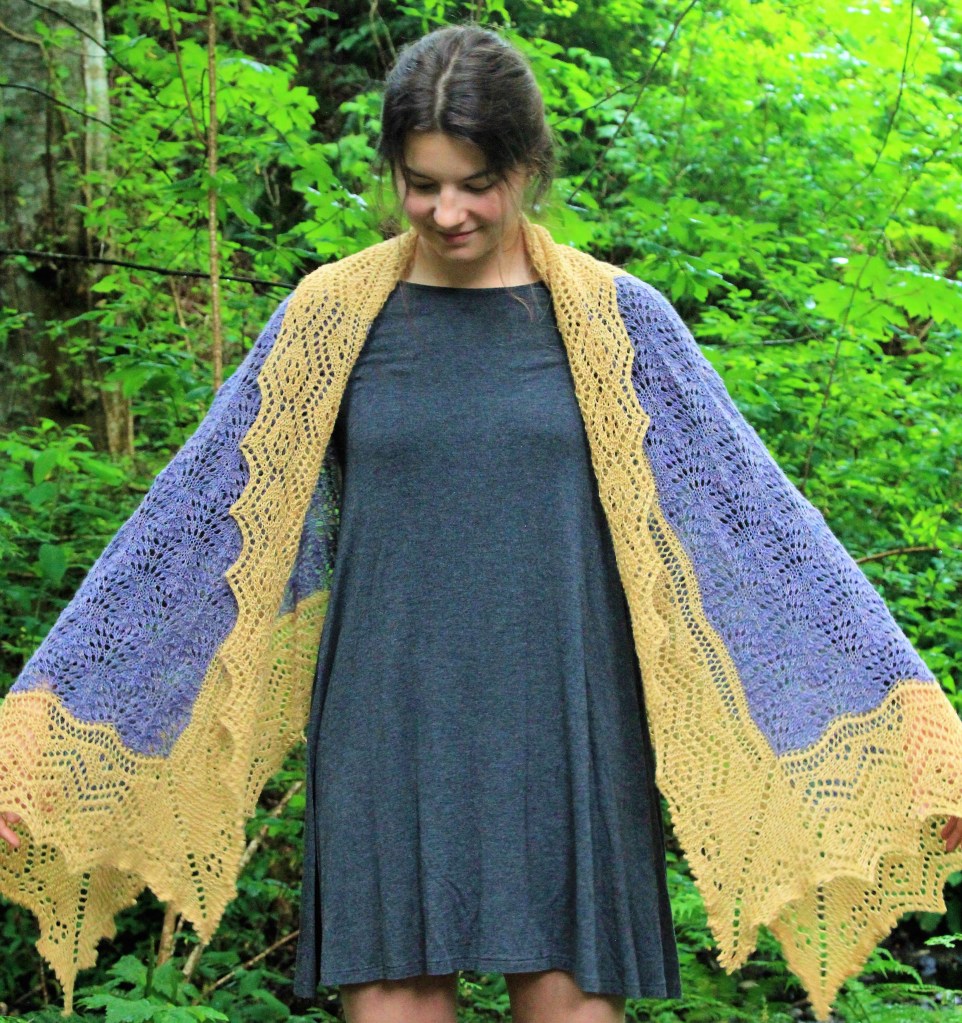
The simpler version of the Plumier stole knit with Handmaiden Flyss.
We were getting pictures of the Pinecones Cowl and of the Plumier Stole, a new pattern that will be ready in two or three weeks. There will be two versions. One version, a little simpler, was knit with Handmaiden Flyss and my favourite version, which is a little bit more challenging but I love the effect. Knit in two colours of BC Garn Bio Shetland. The lace patterns used are all Shetland in origin, my favourite style of lace if I had to pick a favourite! Really I haven’t met a lace pattern that hasn’t called to me in some way! LOL!)
Plumier Stole – knit with BC Garn Bio Shetland – the colours are little brighter than reality.
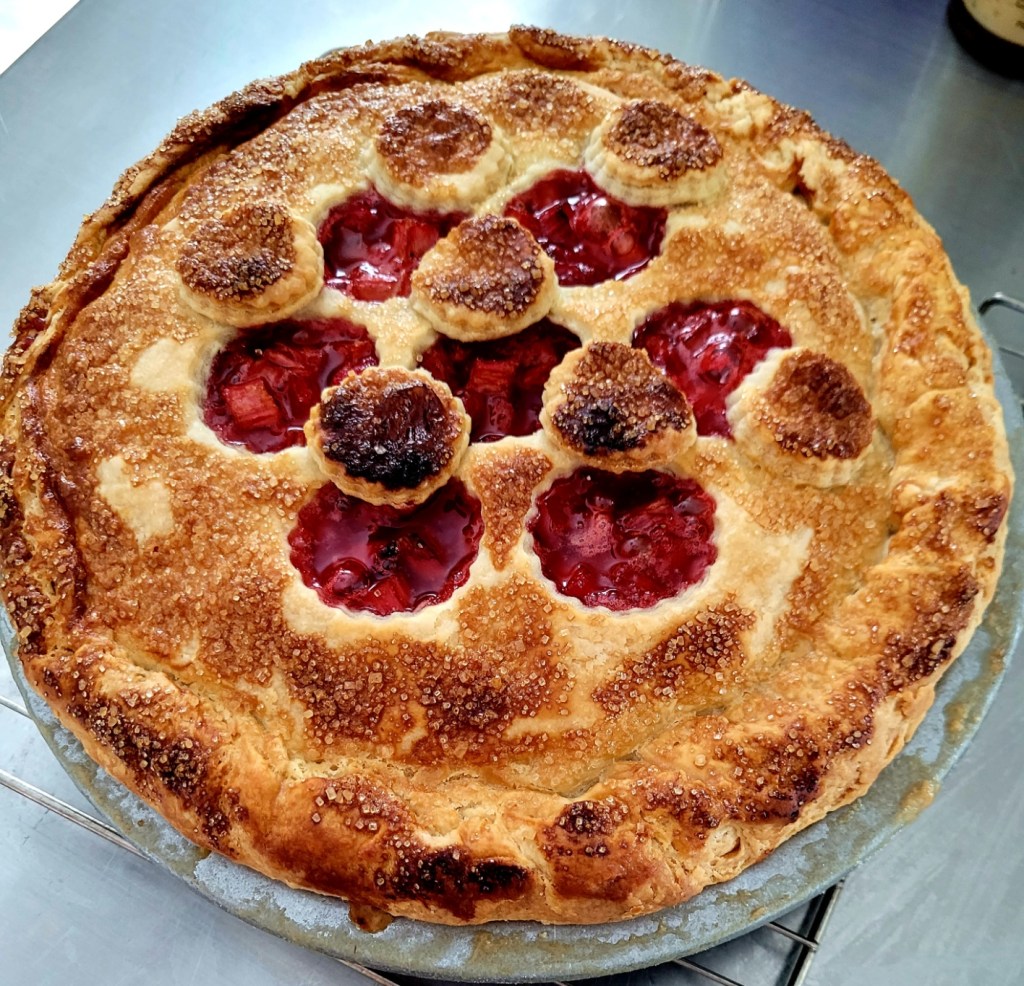
Today we are going to pick some rhubarb from the garden and I am going to make rhubarb strawberry pie – a favourite around here. How do you like your pie? Do you prefer it plain or serve it with whipping cream or ice-cream? We go both ways in our household.
Rhubarb from the garden and purchased Strawberries. It should be the perfect temperature come dessert time.
Well the pattern is up on Ravelry and the kettle is on for tea. The pie is out of the oven and I am ready to sit down and knit for a couple of moments before I contemplate making dinner.
What’s for dinner at your house? Today I am cooking a roast. Sunday I always try to cook something that will produce enough leftovers for at least one meal – keeps life easier after work.